Why I can't find a role
A few months ago, I naively thought finding a role would be easy.
Published: 2026-11-11

I assumed that would make me easier to hire. It didn’t.
This article is my honest answer to why it didn’t, and a clear look at what I can do for your team. Hiring is a mutual choice, so I’d rather you see the real me first.
Why I thought it would be easy
Before coming to Canada in 2024, I spent over eight years in product management across consumer electronics and enterprise software, including a cloud POS platform serving over a million terminals.
When ChatGPT came out in late 2022, I rebuilt my entire workflow around AI out of genuine curiosity. By the time I arrived in Ottawa in 2024, people were asking me to show them how. I helped bring AI tools to students across Carleton University, ran hands-on workshops, and spoke at local tech events.
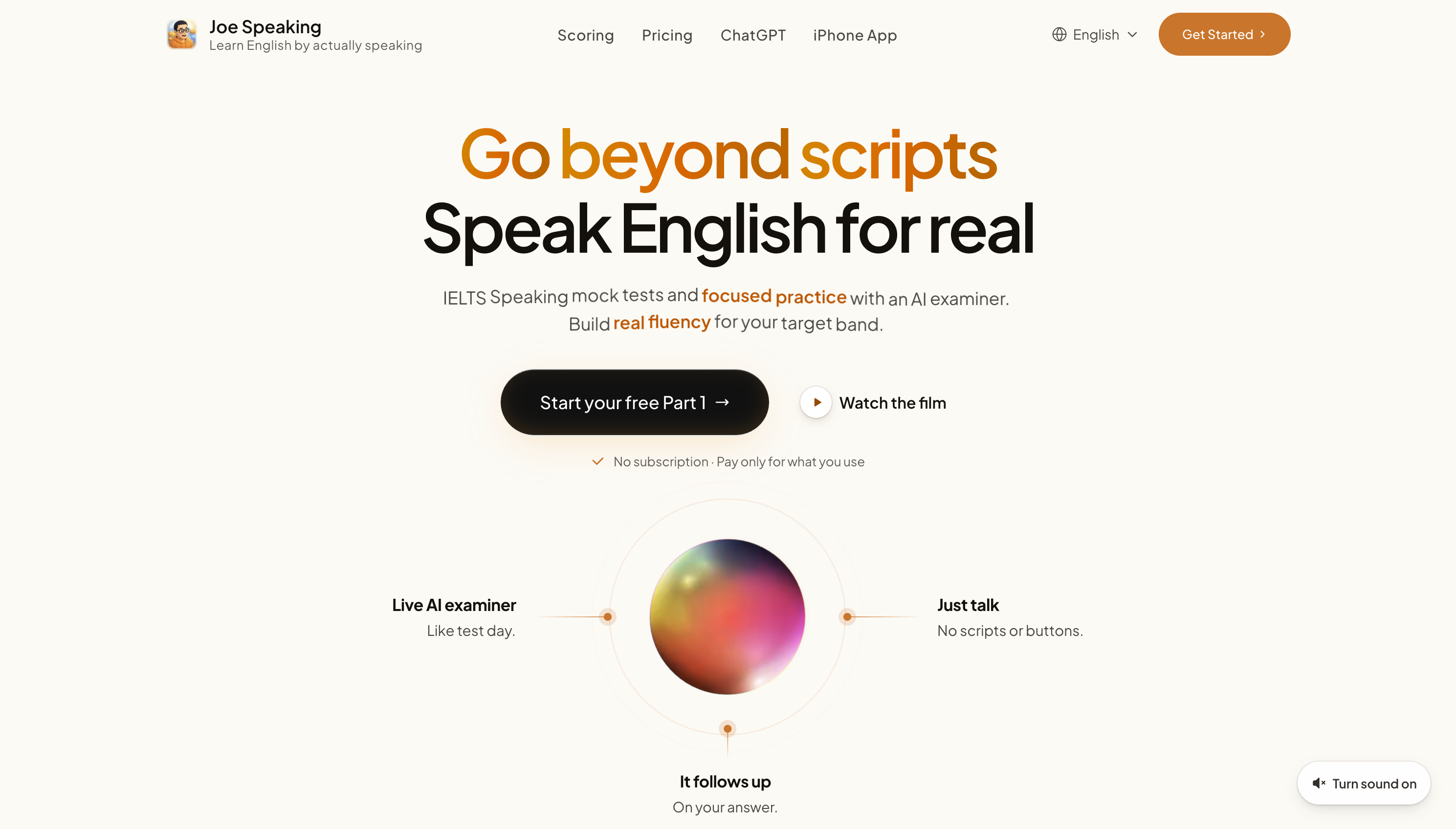
More importantly, AI sparked a personal transformation in how I work and think. Over eight months, without a traditional technical background, I took Joe Speaking from alpha to version 1.0 across web and iOS through 100+ iterations. It is the first platform to use a full-duplex speech-to-speech model to simulate real English speaking exams.
It started with my own struggle to practise English and grew organically to over 3,500 users and 250+ paying learners from day one, without ads.
But I didn’t build it to chase revenue or user numbers. It was a personal exploration of how one person with AI and a bit of idealism can solve a real problem, help people build confidence, and challenge a traditional industry. I learned an immense amount along the way, and it changed my mindset on what one person with high agency can do. I assumed hiring had changed, too.
What actually happened
July. I announced I was looking, and several people reached out. One had a role for me, but I was at YC AI Startup School in San Francisco and followed up too slowly. The window closed.
August. A few local founders reached out, but either the budget or the provincial immigration route I was pursuing then didn’t line up. I also chose to stay in Ottawa instead of moving to Toronto, partly because I believed people here already knew my work.
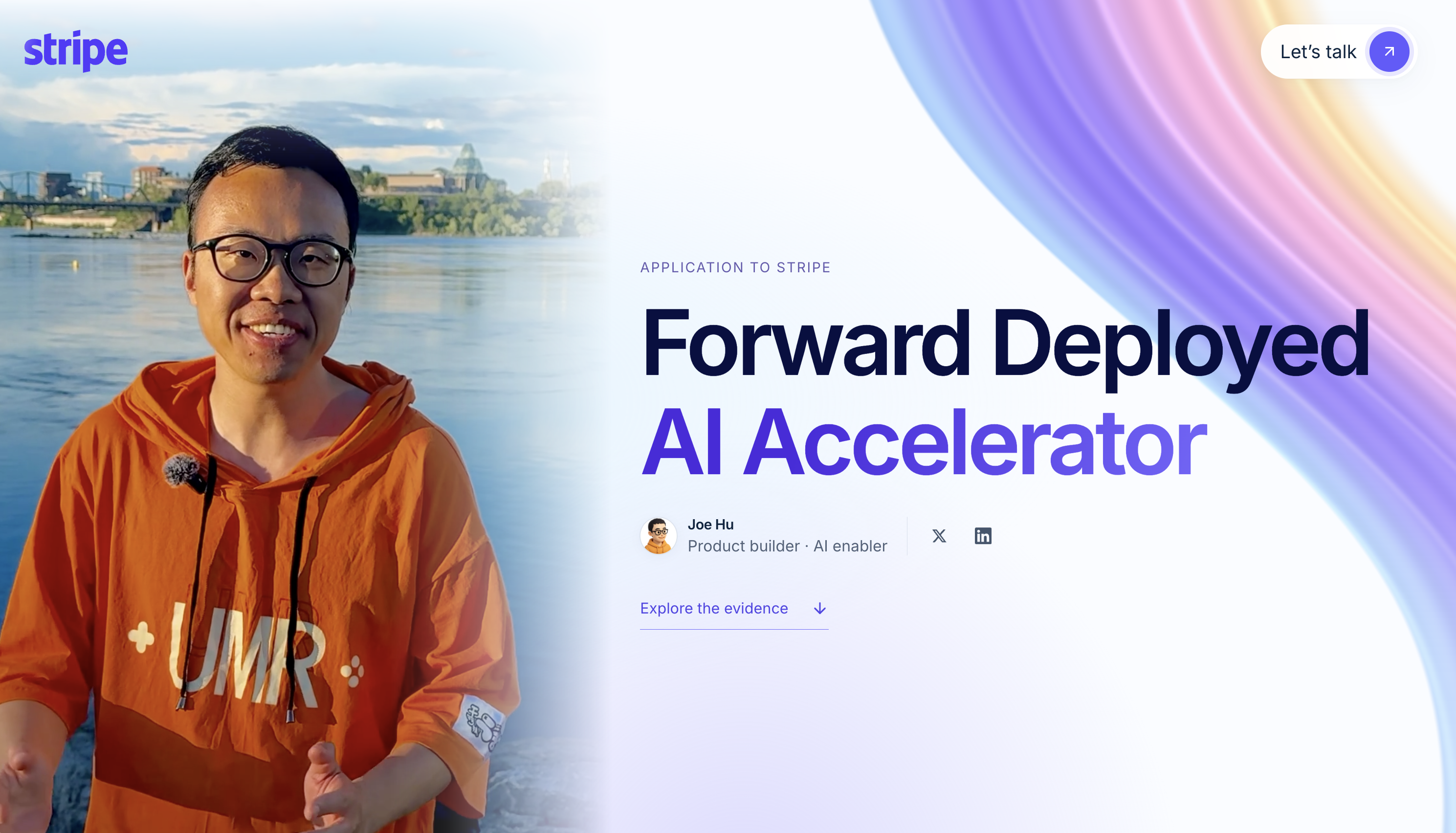
September. I found a role at Stripe I really wanted. Instead of just waiting in the queue, I built a custom website and short film specifically for that application and posted them publicly. The recruiter called the next day. I still didn’t get the role.
Until now. After shipping Joe Speaking 1.0 in October, I built an agent that tailored each application to the role and submitted over 500 applications. It landed three interviews so far, but showed me how hard it is for employers to know a person through an online portal alone. What matters more is expressing myself openly and connecting offline:
- Built a dedicated portfolio page in July to show what I can build and how I work.
- Shared public tutorials on using Claude Code and creating videos with AI.
- Built working prototypes for potential employers before interviewing.
- Reached out to my connections gradually for advice and introductions.
A friend recently told me that looking like a "bootstrapped founder" might make employers worry I’m overqualified or wouldn't want to work for someone else.
To be clear: Joe Speaking is proof of how quickly I can learn, adapt, and break into a new domain through hands-on execution. I want to bring that learning speed to a team for the long term.
Why it hasn’t clicked yet
Looking back at recent interviews, the gap comes down to two things.
First, in short 30-minute interviews, I spent too much time telling my own story instead of focusing on what the employer needed.
Thirty minutes is barely enough to unpack a non-traditional background. I presented myself like a Swiss Army knife: “Look, with AI I can build all of this.” Then I left employers to figure out where I fit. No hiring manager has a problem called “everything.” That part is on me.
Second, how we build software has changed faster than how companies hire for it. And that gap is an opportunity.
Standard hiring filters look for one narrow box at a time: a PM who only writes specs, a designer who only draws screens, or an engineer who waits for tickets. When someone shifts from traditional product management into a builder who connects research, design, code, and growth directly, standard filters miss them.
Yet almost every company is trying to turn AI into real business value. When a hiring system has a blind spot, it creates an opening for leaders who look past standard templates. My next role may be one we define together around a problem that keeps falling between functions.
Why now
Joe Speaking 1.0 is out, and finding a full-time role is now my top priority and a key part of my long-term plan to stay in Canada. Recent Express Entry changes also let me join companies of any size that I previously had to rule out.
Building alone showed me how much one person can do, and made me miss tackling hard problems with a team. So this article is my second try. This time, I’ll start from your problems.
What I can do for you
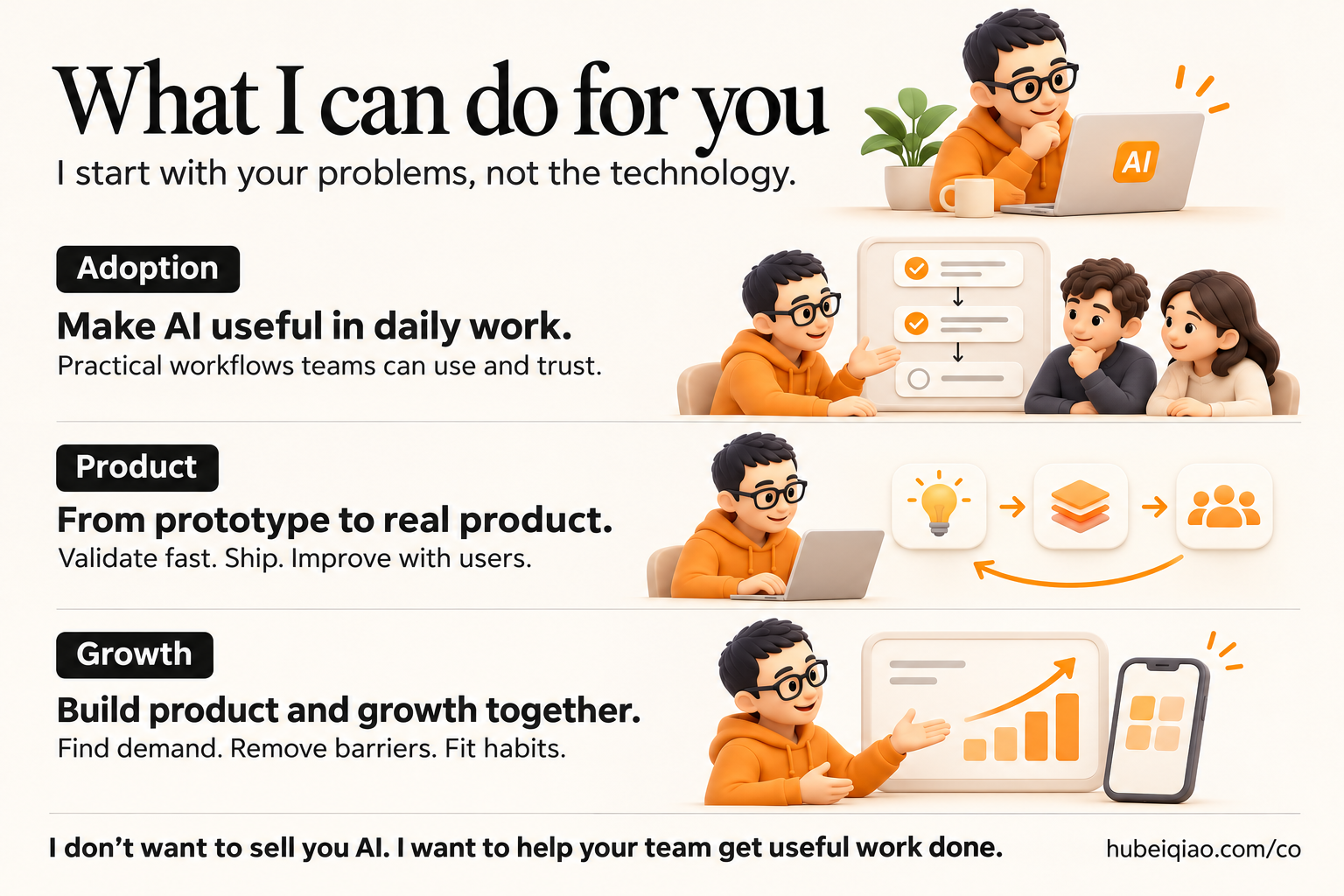
Knowing AI is powerful and making it useful for a business are two very different things. I want to build great products that genuinely solve problems, and I always start by getting my hands dirty to understand how things work on the ground.
1. Upgrade how we get real work done across the team.
When I join a team, I don't treat AI as a separate consulting project; I use it to deliver our actual business goals faster. As we tackle real work across product, research, operations, or support, I build practical AI tools to handle the repetitive bottlenecks slowing us down. Once a workflow is verified and trusted in practice, I help teammates run and build their own. Automating a task isn’t solving a problem; what matters is whether the work gets better, people trust the result, and the team keeps using it.
2. Take a product from rough idea to production, fast.
Whether it is a new customer-facing feature, an internal tool the team has wanted for years, or a new AI capability, we don't need to spend months debating assumptions on paper. I work with the team to decide what is worth building, ship a working prototype in days, and test it with real users.
With Joe Speaking, the first demo was easy. The real work across 100+ iterations was making live voice feel natural under strict exam timing, explaining the scoring logic openly so users trusted it, and building automated checks across real user journeys. I stayed responsible after release: listening to users, fixing what failed, and deciding what came next. That is the ownership I bring to a team.
3. Build your product and its growth together.
How people find a product, access it, and fit it into their lives all influence one another:
- Validate demand first: Before the standalone app, I built an open-source custom GPT that reached 100,000+ conversations and found a second wave of organic growth on RedNote in 2025, over a year after I last touched it.
- Fix adoption barriers through engineering: When learners in mainland China struggled with access, I engineered the real-time voice connection to work reliably without a VPN so it could fit their daily routine.
- Fit existing habits: I built a ChatGPT integration so learners can review their saved progress inside ChatGPT while taking mock tests in Joe Speaking.
Along with my demos, tutorials, and workshops, everything serves one goal: helping people feel confident using a tool that works.
AI didn’t replace my eight years of product experience; it let me put more of it into practice myself and help the people around me accomplish more.
I don’t want to sell you AI. I want to help your team get something useful done.
What I’m looking for
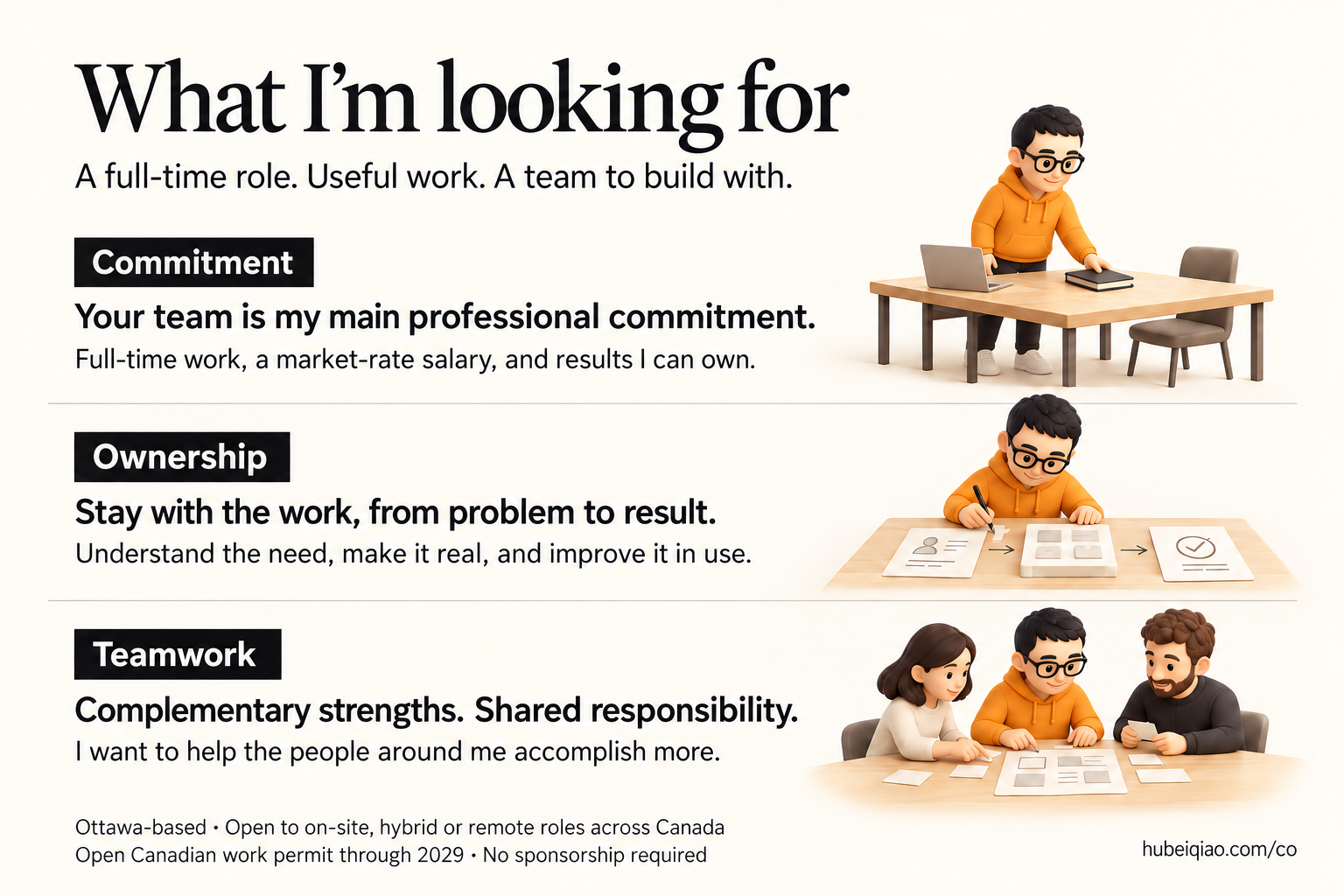
If I join your team, that role will be my primary professional commitment.
I’m looking for a full-time role with a market-rate salary, work I believe in, leaders I respect, and colleagues I can learn from. I want to be proud to tell people: “I work here. This is what we’re building.”
Depending on your stage, here is how I can contribute:
- At an established organization: Start with one team and one practical product or workflow problem, ship a working solution, prove the ROI, and scale what works across the org.
- At a growing company: Turn customer needs into shipped, revenue-driving features faster, while upgrading how the product and engineering teams work with AI.
- At a startup: Take an idea from zero through building, launch, and acquiring the first paying customers.
- At an AI company: Work directly with customers to make your product indispensable in their daily workflows, bridging customer needs and product engineering.
Roles: Product Manager (Senior, Founding, or AI PM), AI Transformation & Adoption Lead, Customer-Facing Solutions / Product Engineer, or a high-agency role we define together around a real business problem.
Location & Authorization: Based in Ottawa and would love to work with a local team; also open to on-site, hybrid, or remote roles across Canada. I hold an open Canadian work permit valid through 2029. No employer sponsorship required.
How we can get to know each other
I’m happy to take part in your interview process. I can also offer a live walkthrough of my product, a candid breakdown of a decision I got wrong, or a small problem we work through together.
A coffee in person tells us a lot, too. Checking the vibe face to face is one thing I’m not handing over to AI.
So, why can’t I find a role?
Part of the answer is that I spent more time showing what I could make than explaining what a team could count on me to own.
The other part is that standard hiring templates aren't built for people who bridge product management, hands-on building, and team-wide AI adoption. Defining that work together around a real opportunity is a conversation I’m ready to have.
Not hiring? You can still help
If someone came to mind while you were reading this, please introduce us.
I’m based in Ottawa and open to teams across Canada. I’d love to hear what you’re working on, and I’m carving out time every week to meet people in person.
Explore my work and reach out here: hubeiqiao.com/co