A Year with Top-Tier AI: Burning 300 Billion Tokens to Build a Product
Every year since 2023, around ChatGPT's birthday in late November, I write one of these. The first two were about ChatGPT.
Published: 2026-11-18
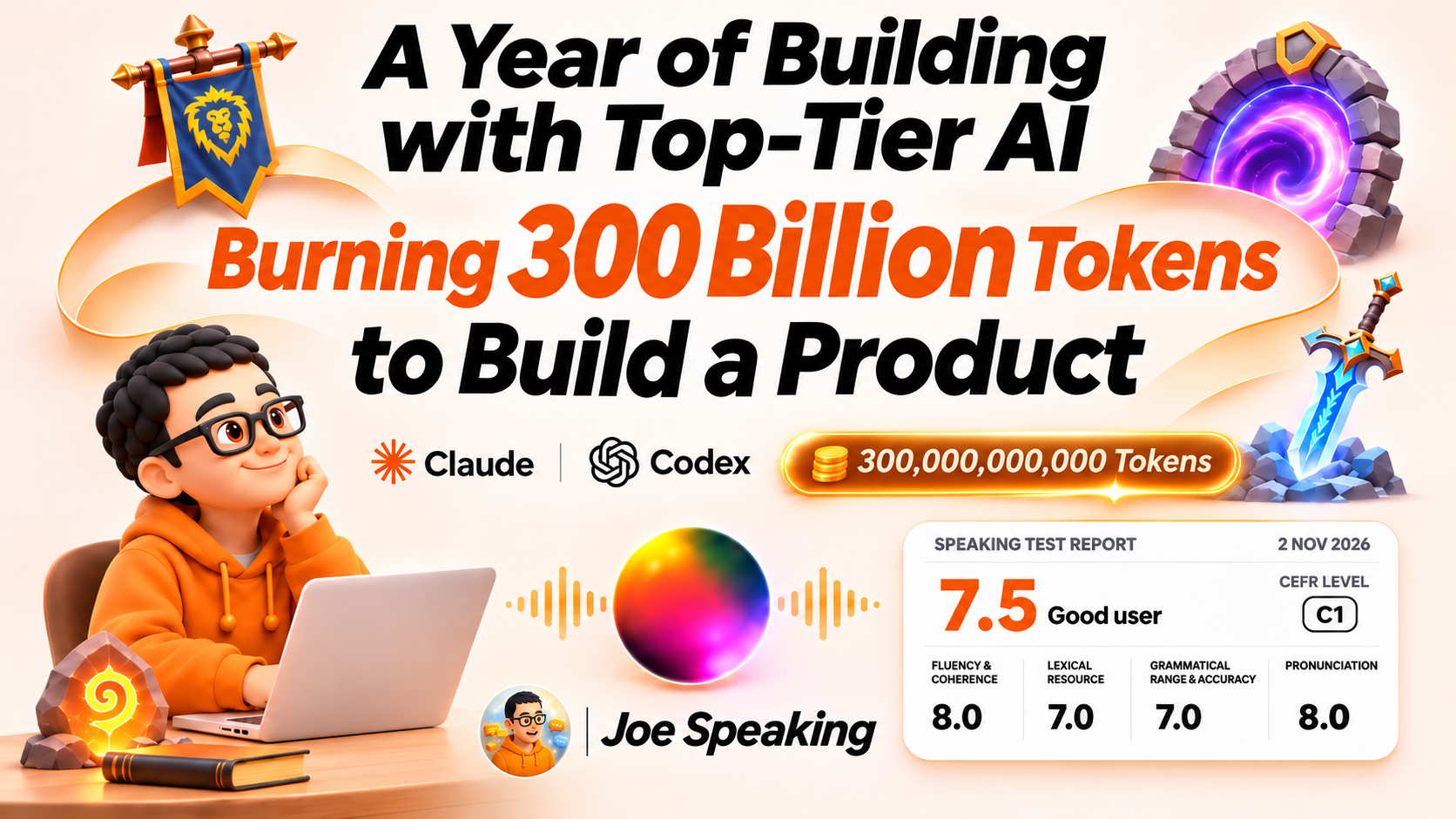
This time last year, I naively thought one month of a $200 AI plan would be enough to build the whole product.
Then another billing email showed up yesterday, and I realized it's been a full year.
Back then it didn't even have a name. Now it's Joe Speaking. You take a live IELTS or CELPIP mock test with an AI examiner, and afterward it shows you how to say each answer more naturally. You can even connect your practice history to ChatGPT or Claude and ask them what to work on next.
Over 3,000 people have signed up, and more than 200 have paid. I'm biased, but I think it's the best speaking app out there. It's also the first thing I've built that I'm really proud of.
The $200 a Month That Taught Me More Than Tuition
For most of the past year, my daily routine was basically figuring out how to use up all of my weekly AI limits.
In API terms, I started out thinking $200 in a single day was already a lot. These days, on heavy days, I've gone past $2,000. By an incomplete count from AI Usage, a tracker my friend Xiaozhe built, I've used nearly 300 billion tokens so far. At official API prices, that's close to $160,000.
What I actually spent on subscriptions comes to a little over $2,000 by my rough math. It still feels unreal. That's a subsidy of more than 60x.
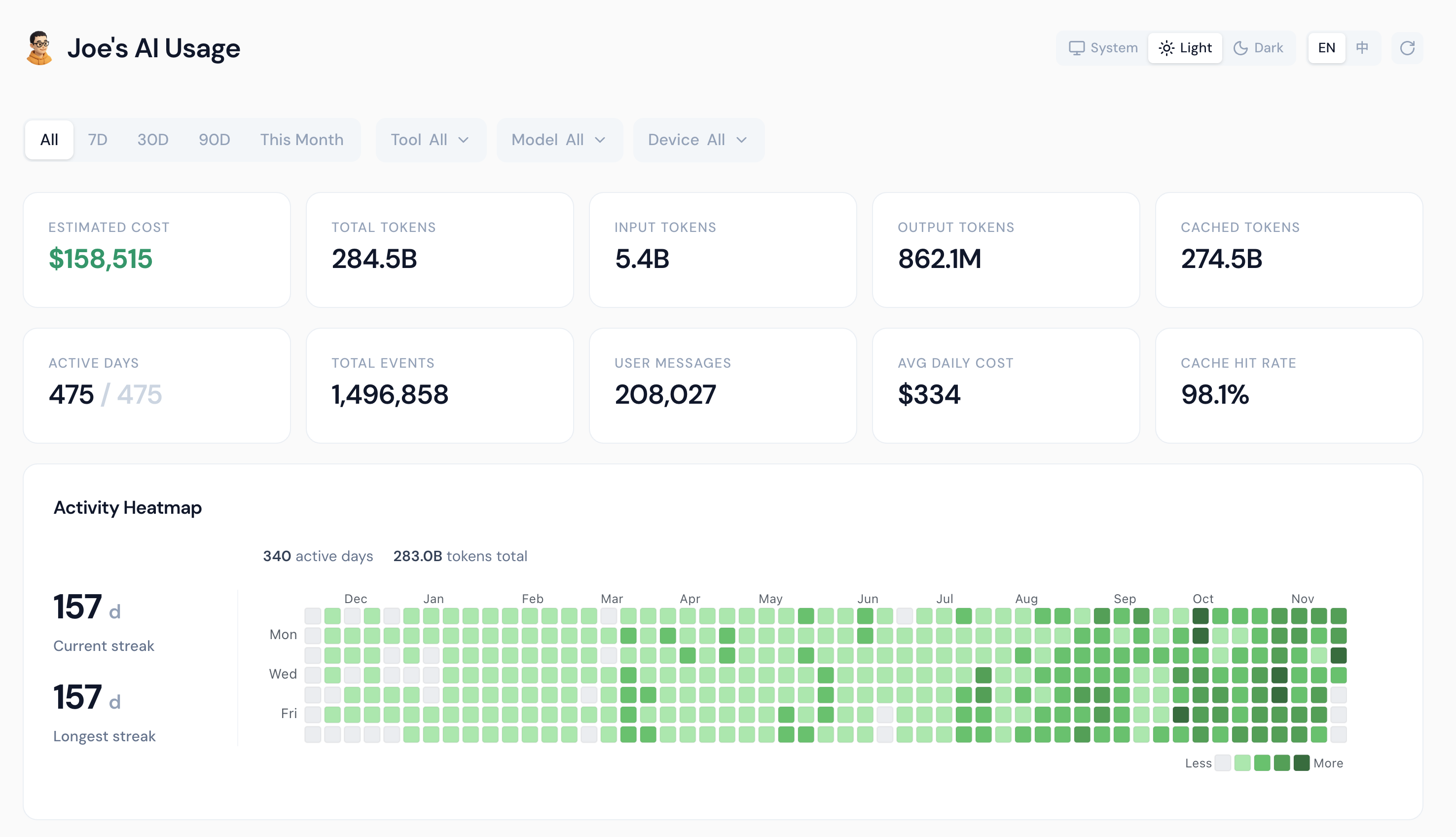
These days my fixed AI subscriptions add up to at least $400 a month: $200 for Claude, $200 for ChatGPT Pro, plus Grok and Gemini Pro. If you think of that as hiring a team that works around the clock, it's an incredible deal.
I came to Canada for school in 2024, and people often ask what program I'm in. My answer is always that it doesn't really matter. What matters is what you're building and what you want to do. My program costs 15,000 CAD for each four-month term.
Just in terms of what I learned this year, a $200-a-month AI subscription beat the classroom by a long way. (I suspect schools will increasingly have to stand out through the in-person experiences nothing else can replace.) When you build your own product, every problem you hit is one you have to understand, and you use what you learn right away.
A classmate once asked me how I learned all this. I told him to get Claude Max right away. He said it was too expensive, and that was the end of it.
Honestly, that $2,000 or so was some of the best money I've ever spent, a once-in-a-lifetime experience. It gave me my first real taste of the joy of making things, and I ended up with a product that's mine and actually helps people.
From Clicking Accept All Day to Working From Bed
Looking back at this past year, the way I work and what I can build have both changed completely.
A year ago I only made simple demos and prototypes and didn't dare try anything complicated. My main job was sitting at my computer frantically clicking "Accept" over and over, checking what the AI produced, trying things myself, and giving feedback and complaining. I was the AI's babysitter.
Even at that "slow" pace, I was more hooked than I'd ever been on World of Warcraft.
A year later, I have a product that's live and has real users. I'm making videos I never imagined I could make, and I feel confident trying things I've never done before.
Lately I've been obsessed with World of Warcraft: Forever, logging close to 100 hours in the past two weeks. While I play, my AI agents keep working in the background on a goal-based redesign of Joe Speaking. Most days I review their work and hand out new tasks from bed. I'm literally working lying down.
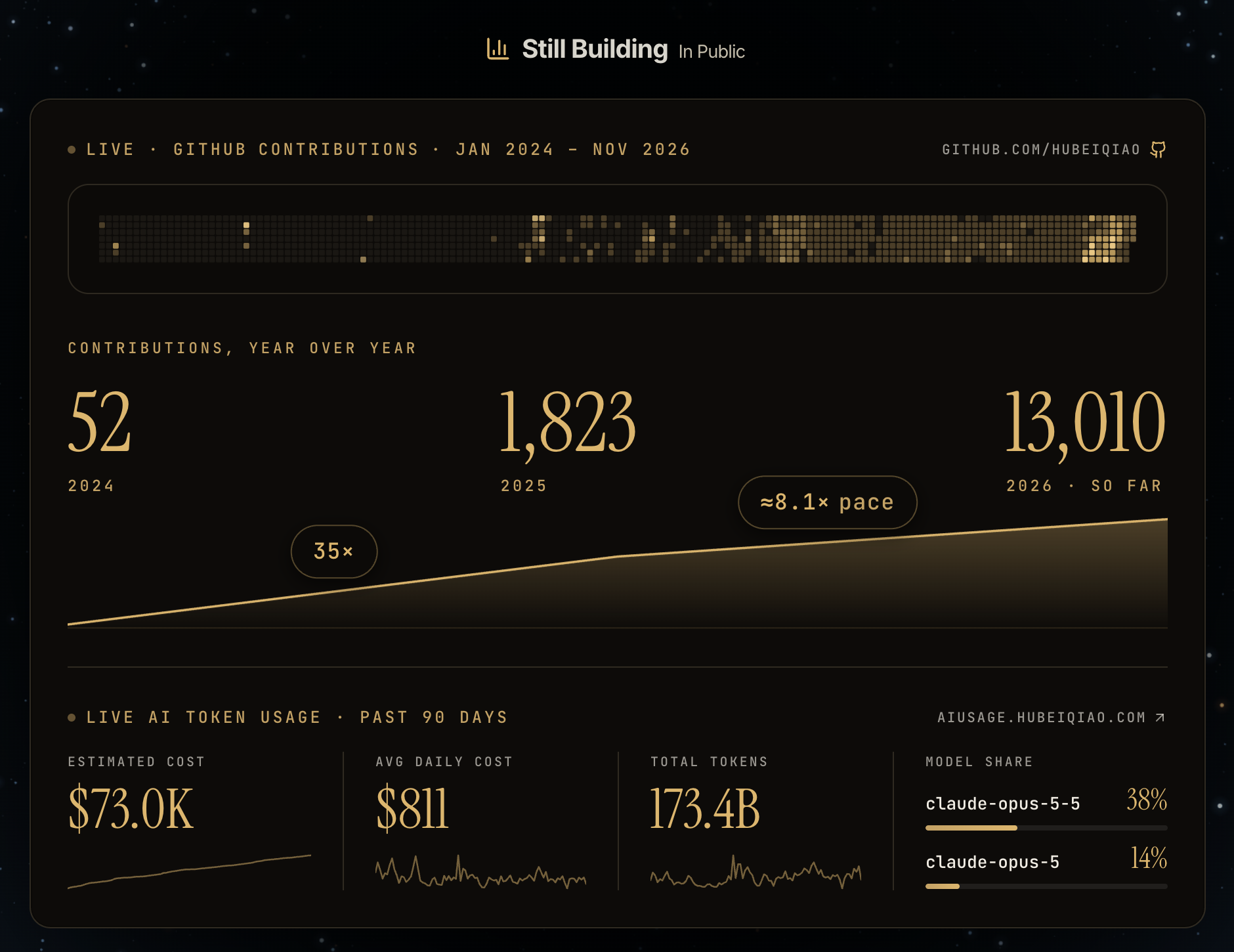
According to GitHub, I made 35 times as many commits in 2025 as in 2024, and so far 2026 is at 8 times 2025. More commits obviously doesn't mean a better product, but looking back at these numbers still feels a bit crazy. A year ago, I never thought I could move this many things forward.
I'm still the one who decides what to build, how far to take it, and whether the result is good enough. I just don't have to sit at my computer all day like I did a year ago.
Joe Speaking: An Idealistic Experiment
I never expected to spend most of my working time in 2026 on Joe Speaking.
In September last year, I started reading papers. In October I began running local experiments. By November I still hadn't really started on a product. Then I listened to a podcast with Karpathy. Using his own experience learning Korean, he said the models back then still couldn't be the kind of really good private tutor he had in mind.
So I decided to just build the part where you start speaking, and figure out the teaching later. That was the beginning of Joe Speaking.
I didn't expect how much would come after that. Fitting open-ended, real-time voice into a strict exam flow meant running into one problem after another, and it took at least half my time and energy. Gemini Live caused me the most trouble. I picked it for the price and thought I could launch in a week. It took several months to become reasonably stable, and I knew there were still plenty of problems. Only after the gpt-live-1 API came out did things finally settle down, which gave me more energy for everything else.
Today Joe Speaking is a lot of systems working together, something I couldn't have imagined a year ago. Sometimes I get a little full of myself and think, this is really good.
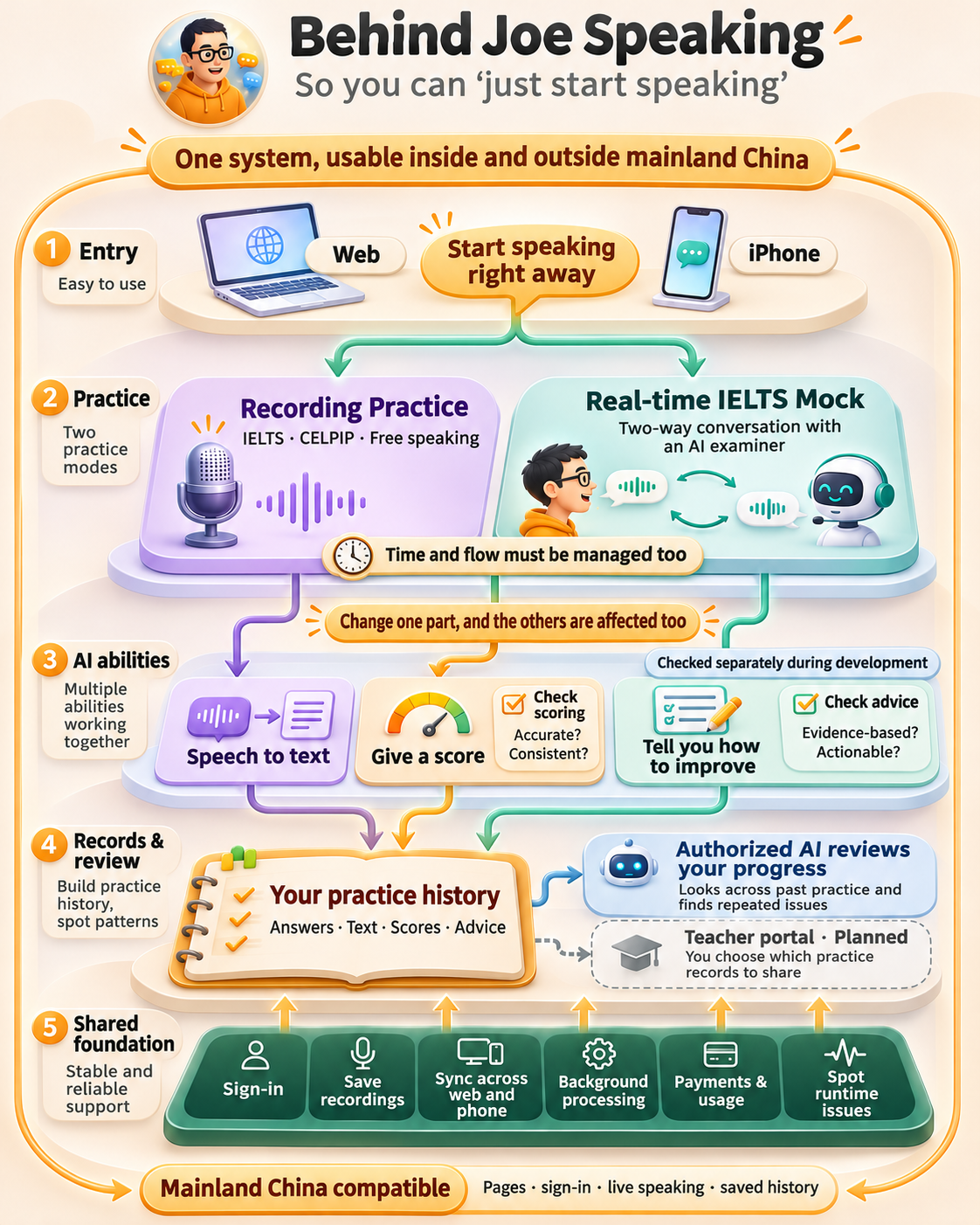
AI let someone like me, with years of product experience but no software engineering background, turn a small recording tool into a real, running service. Along the way I finally understood what it means to do something right, how to check whether it's reliable, how to be upfront when I hit an edge case I can't handle, and how to take responsibility for what users actually experience. Every payment still floors me, especially the recent run of $50 top-ups.
At first I tested everything myself, by hand. Over time I moved to automated checks, like having two AIs hold mock conversations with each other and running scoring calibration again and again. I even published the full scoring criteria. Now there's a full set of "sentries" in the system too: alerts the moment the service wobbles, production errors investigated and fixed automatically every day, a full checkup before every update, and more.
All in all, my users have it pretty good. I just want to make it the best and most affordable speaking app, one that even supports bringing your own API key, and help more people who've been in my shoes.
Getting My Hands Dirty Taught Me to Respect Engineering
Getting Joe Speaking to where it is today also cured some of the naivety I had a year ago.
Back then I thought that once I could build something, I'd be unstoppable. I found out later that getting it built was only the beginning.
At first I thought engineering was simple: hand it to AI and it comes out done. Then I actually ran into all of it myself, including the infrastructure underneath. This year I paid Vercel, Supabase, GitHub and Cloudflare plenty of "tuition" before I slowly learned what to optimize, why to optimize it, and how testing and releases really work.
You really have to do it yourself. Even when AI writes the code, you're the one who has to deal with the problems. That's how you find out where the details are, and how you come to respect them.
Building software has gotten easier. Building a product that's actually useful, solves real problems and keeps getting better is still very hard. Users send feedback, features break, and every change comes with new trade-offs. None of that stops once the first version is out.
So when I hear "we'll just vibe-code one ourselves," I react differently than I did a year ago. A lot of the time, paying a few dozen dollars a month for a ready-made service really is better. Building everything yourself and then keeping it all alive on your own is exhausting just to think about.
And a lot of judgment can't be copied by grabbing a skill or a workflow, or by switching tools. If you don't do it yourself, you don't even know what you don't know.
That's why I think more and more people will have their own craft. Make one thing really well, make it solve a problem for someone, and they'll be glad to pay for it. I really like that feeling.
Living in the Future, but Wanting to Slow Down
A few months ago, I naively thought that with everything I'd built, I could easily find a job if I ever needed one. It's been harder than I expected. Part of that is on me: I'm still learning to explain clearly where someone like me fits. Part of it is that the way we build software is changing faster than the way companies hire for it, and I happen to be living right inside that change.
Now, at the end of 2026, what I predicted has pretty much come true: almost anything you want to do on a computer can be done, limited only by tokens and hardware. So even though I haven't found the right role yet, I feel good about what I can bring. I'd love to help a team that wants to work this way. Either way, I'm building every day, same as always.
I'm already living a post-AGI life, working only on what I want. Honestly, I don't know what the world will look like in 2029.
In a time when everything goes out of date so quickly, building something of your own like a craftsperson, without chasing anyone's pace, is a way of following your passion and curiosity. I think that's worth a lot.
More than ten years later, I'm back in Azeroth. This time the world isn't as convenient as the main game, and everything is slower, but it's really made me see the upside of slow. I think the most important thing is to stay fairly relaxed, not be in a rush, and go at your own pace instead of treating life like a forced march.
The world outside is still fast. Anthropic goes public tomorrow, and I hope Jensen comes back to NVIDIA!
I believe 2027 will be even more exciting. But because AI moves so fast, choosing to slow down, or even do nothing at all, has become more valuable.
Go enjoy your life.